
Experiment - Study reveals a way to improve chances of winning at rock-paper-scissors
Reference - ßPhys.org by Bob Yirka
A trio of researchers at Zhejiang University in China has found a way for players to improve their odds of winning when playing the hand game rock-paper-scissors. In their paper they've uploaded to the preprint server arXiv, the researchers describe a field study they undertook with a large crowd of volunteers and how it revealed the secret.
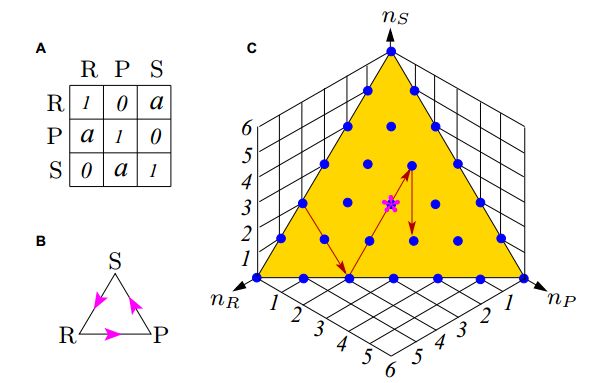
The Rock-Paper-Scissors game. (A) Each matrix entry specifies the row action’s payoff. (B) Non-transitive dominance relations (R beats S, P beats R, S beats P) among the three actions. (C) The social state plane for a population of size N = 6. Each filled circle denotes a social state (nR, nP , nS); the star marks the centroid c0; the arrows indicate three social state transitions at game rounds t = 1, 2, 3. Credit: arXiv:1404.5199 [physics.soc-ph]
Scientists in many fields have studied game theory for thousands of years, some to gain military or social advantage, others to better understand human psychology. One game stands out, the hand game rock-paper-scissors, likely because of its simplicity, and because it can be used to make group decisions. Plus, it's universal, requiring no language skills or preconceived social notions—therein lies its inherent beauty. Also, it's supposed to be fair, with every player having a 1 in 3 chance of winning any given round. Prior research has suggested that such odds are the case, but now, it appears the experts may have been wrong. In this new effort, the team in China has found that due to human emotion and decision-making strategy, there is a way to better the odds when playing.
Zhou Haijun is part of the Institute of Theoretical Physics of the Chinese Academy of Science. Wang Zhijian and Xu Bin of the Experimental Social Science Laboratory at Zhejiang University wrote a paper titled Social Cycling and Conditional Responses in the Rock Paper Scissors Game.
To find it, the researchers recruited 300 volunteers from the university and divided them up into 60 groups and had them play the game. Winners were given different amounts of money to make sure that all players were trying to win. As the horde played, swapping teams periodically, the researchers filmed the action and afterwards, studied the tape. They found that players had a slight tendency to repeat a wining throw, and, to give up on a throw if they lost using it more than twice in a row. That meant, the researchers report, that in order to improve their chances of winning, all a player had to do was throw down a gesture that would beat the previous winner or throw down a gesture that would beat one of the other two gestures a prior loser had not just used.
The researchers note that such predictable play is easy to explain—people naturally continue with a winning strategy and avoid those that don't work. They call it the "win-stay, lose-shift" strategy, which because most of the people playing use it, results in any given player winning a third of the time—but, not if they know about the strategy used by their opponents, and their opponents don't. Because the analysis came after the game playing, the researchers didn't have the opportunity to test their theory that they'd found a winning strategy, but now that the cat's out of the bag, it's likely people all over the world will be testing it for them.
Reference -Phys.org by Bob Yirka